
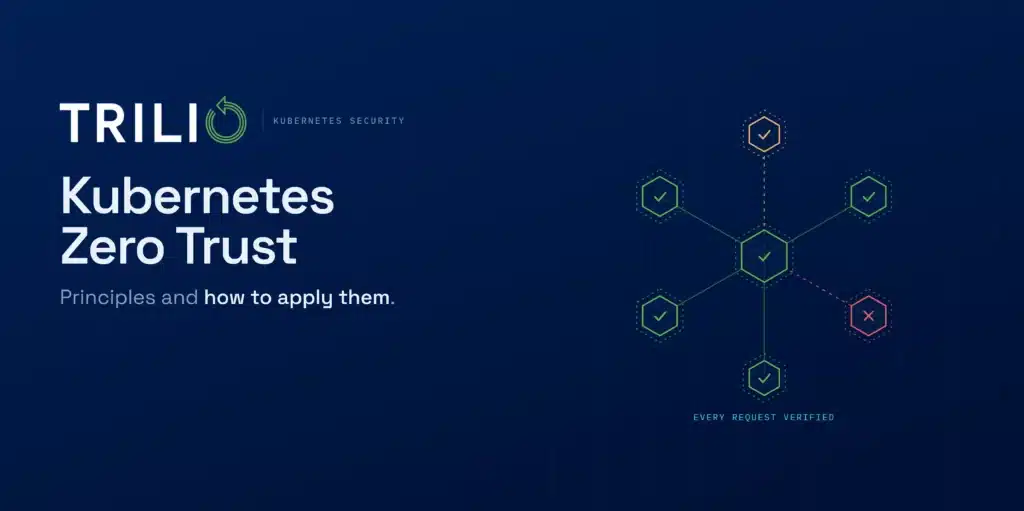
Kubernetes trusts everything inside the cluster by default. Any pod can reach any other pod, IPs change with every rolling deployment, and one compromised container gives an attacker a path across your entire environment. Kubernetes zero trust replaces that default with a simple rule: Never trust, always verify, regardless of where a request comes from.
Zero trust for Kubernetes is an architectural model that touches every layer of your stack. It covers identity, network policy, workload security, and the pieces most teams skip: data protection and recovery. Below, you’ll find the core principles behind a zero-trust architecture in Kubernetes, plus concrete steps for implementing zero-trust security in Kubernetes, from ServiceAccounts and network policies to immutable backups that hold up when prevention fails. Each control closes a gap that attackers actively probe for.
What Kubernetes Zero Trust Means and Why the Cluster Perimeter Is Not Enough
Before you can apply zero trust to a cluster, you need a clear picture of what the model actually demands and why the traditional perimeter approach fails specifically within Kubernetes. Both points shape every decision you will make when implementing zero trust security in Kubernetes.
Zero Trust Kubernetes in Plain Terms
Zero trust rests on three principles:
- Never trust, always verify
- Assume that a breach has already happened
- Grant only the least privilege each request needs
No user, pod, or service earns access simply because of where it sits on the network.
Zero-trust Kubernetes is a design model—an architectural approach you commit to. You cannot install it once and check a box. There is no “zero trust operator” that solves the problem with a single Helm chart. Zero trust architecture in Kubernetes is a series of decisions applied across four layers: identity, networking, workloads, and data.
Kubernetes zero trust means every request inside the cluster is authenticated, authorized, and encrypted, regardless of its origin. Network location grants nothing.
Why Perimeter Security Breaks Down Inside Kubernetes
The castle-and-moat model wraps a hard shell of firewalls and gateways around a soft interior, where anything inside the wall is trusted by default. That assumption collapses inside a cluster. The default Kubernetes network is flat, which means any pod can talk to any other pod on any port, with no internal barriers unless you build them yourself.
Pods are also ephemeral. IP addresses change with every rescheduling event, so IP-based firewall rules rot within hours of being written. When internal traffic runs unrestricted, a single compromised pod becomes a launchpad. An attacker who lands in a vulnerable frontend container can probe databases, scrape secrets, and move laterally without ever crossing your perimeter again. The Tesla cryptomining incident began with one exposed dashboard and unrestricted internal access.
These are the three structural gaps that make perimeter defenses unreliable inside a cluster:
- Flat networking by default: Every pod can reach every other pod on every port until you explicitly restrict that traffic.
- Ephemeral workloads: Pod IPs change constantly, so any rule tied to a network address becomes stale almost immediately.
- Unrestricted lateral movement: Once an attacker gets inside, nothing stops them from pivoting between services because the perimeter only guards the entry point.
Why Zero Trust Kubernetes Matters Now
Clusters no longer sit in one datacenter behind one firewall. Multi-cluster, hybrid, and multi-cloud deployments spread workloads across networks you do not fully control, and teams routinely move applications between environments. Implicit trust based on network location has nothing left to stand on in that setup. Identity-based verification is what remains, and that is exactly what zero trust for Kubernetes delivers: Every workload proves who it is, every time, no matter where it runs.
Core Principles of a Zero Trust Architecture in Kubernetes
Every zero trust architecture in Kubernetes rests on four principles that reinforce each other. If one is missing, the others lose much of their strength. Here’s how each principle works and what it looks like when applied to a real cluster.
Identity as the New Boundary
Traditional networks used location as a proxy for trust. A request originating inside the firewall was assumed to be legitimate. Zero-trust Kubernetes reverses that assumption: Identity replaces network location as the thing you verify on every connection.
Inside a cluster, that identity belongs to workloads, not just people. Every pod runs under a ServiceAccount, and that ServiceAccount becomes the basis for what the workload can access. More mature setups go further with cryptographic identity, issuing each workload a short-lived certificate that proves who it is on every connection. Frameworks like SPIFFE exist precisely because IP addresses in Kubernetes churn far too quickly to serve as trustworthy identifiers. A pod’s IP might belong to an entirely different workload ten minutes later.
Least Privilege and Explicit Policy
Once every workload carries an identity, you grant it the minimum access it needs and nothing more. Least privilege in Kubernetes means explicit allow policies scoped per identity, protocol, and purpose. For example, your payment service can query the orders database over PostgreSQL on port 5432, and that’s the full extent of it. It cannot reach the admin API, the logging backend, or another namespace because nothing explicitly permits it to.
The operative word is explicit. Anything not deliberately allowed is denied by default, which turns every access grant into a documented, reviewable decision rather than an accident of network topology. Teams implementing zero trust security in Kubernetes often find that this discipline pays off during audits, since every permitted connection maps to a written policy someone approved.
Microsegmentation and Limiting Blast Radius
Microsegmentation takes explicit policies and uses them to carve the cluster into small, isolated communication paths. Instead of one flat network, you get dozens of narrow lanes, each permitting only the traffic a specific application actually requires.
The payoff shows up when something goes wrong. If an attacker compromises a frontend pod, segmentation confines them to whatever that single pod was allowed to reach. Pairing this containment strategy with a tested ransomware recovery plan gives you both a smaller incident and a faster path back to normal operations.
Continuous Verification
The final principle is that verification never stops. A request authenticated an hour ago earns no credit now. Every call gets authenticated and authorized at the moment it happens, using current identity and current policy. That constant rechecking is what separates genuine zero trust for Kubernetes from a one-time hardening exercise.
Continuous verification also extends beyond individual requests. Logging and monitoring act as ongoing checks that your policies actually hold: audit logs from the API server, network flow data, and runtime alerts tell you whether reality matches intent. Treat this as a feedback loop rather than a one-time setup. Policies drift, workloads change, and the only way to know your zero trust architecture in Kubernetes still works is to keep watching it.
Watch this 1-min video to see how easily you can recover K8s, VMs, and containers
Implementing Zero-Trust Security in Kubernetes Across the Stack
Principles only matter once they become configuration. Implementing zero-trust security in Kubernetes means applying controls at four layers: network, identity, workload, and process. The good news is that each layer relies on tools you probably already have access to, so building a zero trust architecture in Kubernetes is more about deliberate configuration than new purchases.
Control the Network and Service-to-Service Traffic
Begin with default-deny NetworkPolicies in every namespace, then add explicit allow rules for the traffic each application genuinely needs. CNI plugins like Calico and Cilium enforce these policies at the kernel level, and both support identity-aware rules that survive pod churn, which is a core requirement for zero trust for Kubernetes environments where IP addresses change constantly.
For east-west traffic, a service mesh such as Istio or Linkerd adds mutual TLS, so every service-to-service connection is encrypted and authenticated with workload certificates. Apply the same scrutiny to north-south traffic at your ingress, and do not overlook the control plane: the API server, etcd, and kubelet endpoints deserve the same restrictions as your application pods.
Enforce Identity and Access
Role-based access control is where least privilege becomes enforceable. Write narrowly scoped roles bound to specific namespaces, and resist the pull of cluster-admin as a convenience. Every workload should run under its own dedicated ServiceAccount rather than the default one, which quietly accumulates permissions nobody remembers granting.
For human access, integrate an external identity provider (Okta, Microsoft Entra ID, or Keycloak) through OIDC, so authentication ties back to your organization’s directory, with MFA and short-lived sessions instead of long-lived kubeconfig files. This is one of the fastest wins in any Kubernetes zero-trust rollout because it closes off stale credentials without touching a single workload.
Secure the Workload and Supply Chain
Zero trust applies before a pod ever runs. The following sequence walks through locking down the workload path from build to admission:
- Scan images in CI: Use tools like Trivy or Grype, and fail builds on critical vulnerabilities rather than logging them for later.
- Sign your images: Sigstore Cosign lets your cluster verify provenance cryptographically before anything runs.
- Enforce policy at admission: Kyverno or OPA Gatekeeper can reject unsigned images, privileged containers, and pods that request host access.
- Lock down CI/CD credentials: A compromised pipeline can push anything past your other controls, so treat pipeline secrets as high-value targets.
Following this sequence means untrusted code gets stopped at the door instead of hunted down at runtime.
An admission controller that verifies image signatures does more for your cluster than a dozen runtime alerts. Prevention at deploy time is cheaper than detection at 3 am.
Align to Recognized Frameworks
You do not have to invent zero-trust architecture in Kubernetes from scratch. NIST Special Publication 800-207 defines the reference model for zero trust, the CISA Zero Trust Maturity Model gives you staged milestones to measure progress against, and the NSA/CISA Kubernetes Hardening Guide translates both into cluster-specific recommendations. Anchoring your zero-trust security for Kubernetes roadmap to these documents keeps internal debates grounded in neutral guidance rather than vendor claims.
Extending Zero Trust for Kubernetes to Data Protection and Recovery
Most zero-trust conversations end at prevention: identity, network policy, admission control. But the model’s core assumption, that a breach will happen, raises an uncomfortable question. When it does, can you get your data back?
Why Backup and Recovery Are the Missing Layer in Most Zero Trust Plans
Identity, network, and runtime controls govern who can do what, but none of them protect the data itself. If an attacker gains valid credentials or exploits a workload despite your policies, they can encrypt persistent volumes, delete secrets, and wipe application state, all within the boundaries you granted them.
Taking “assume breach” seriously means keeping a tamper-resistant, recoverable copy of every critical workload. Yet most teams implementing zero-trust security in Kubernetes skip this layer entirely, treating backup as an operations task rather than a security control. That gap is exactly where ransomware operators make their money.
Applying Zero-Trust Principles to Backups
A Kubernetes zero-trust strategy should govern the backup infrastructure with the same rigor it applies to the cluster. The table below shows how each core principle translates from one layer to the other.
| Principle | In the Cluster | In the Backup Layer |
|---|---|---|
| Least privilege | Scoped RBAC and ServiceAccounts | Separate credentials for backup operations, no shared admin access |
| Assume breach | Microsegmentation limits lateral movement | Immutable backups that cannot be altered or deleted |
| Verify explicitly | mTLS and authenticated requests | Encrypted backup data, in transit and at rest |
| Limit blast radius | Namespace and network isolation | Backup targets isolated from the cluster they protect |
Isolation deserves particular emphasis. If backups live inside the compromised cluster or use credentials reachable from it, they fall with everything else. Zero trust for Kubernetes only holds up when the recovery layer sits outside the attacker’s reach.

Automated Kubernetes Data Protection & Intelligent Recovery
Perform secure application-centric backups of containers, VMs, helm & operators
Use pre-staged snapshots to instantly test, transform, and restore during recovery
Scale with fully automated policy-driven backup-and-restore workflows
Recovery as the Last Line of Defense Against Ransomware and Lateral-Movement Attacks
When prevention fails, recoverability determines whether an incident costs you hours or weeks. Kubernetes applications are more than volumes. Restoring them means capturing metadata, configurations, and persistent data together, in an application-consistent state, so application recovery returns a working system instead of a pile of disconnected resources.
This is where Trilio for Kubernetes fits into a zero-trust architecture in Kubernetes. It uses native APIs to back up entire applications, applies pre- and post-backup hooks so databases like PostgreSQL and MySQL stay consistent, and stores copies on NFS or S3-compatible targets outside the cluster, with immutability available on S3-compatible object stores that have Object Lock and versioning enabled. Point-in-time restores and cross-cluster recovery give your team a verified path back to a known-good state after ransomware or lateral-movement attacks, which is what zero trust security for Kubernetes ultimately promises: continuity, even after a breach.
A zero trust plan without recoverable, isolated backups only manages how a breach begins, never how it ends.
See how Trilio for Kubernetes closes the recovery gap in your zero trust strategy.
Conclusion
Zero trust for Kubernetes works when you treat it as a series of connected decisions instead of a one-off project. Identity, explicit policy, segmentation, and continuous verification limit how far an attacker can move through your environment. An isolated, immutable copy of your applications determines how fast you recover when something gets through anyway. Teams that plan for both prevention and recovery tend to resolve incidents in hours. Teams that stop at prevention often struggle for far longer.
The practical way to begin implementing zero trust security in Kubernetes is to start small and stay specific. Choose one namespace, apply a default-deny policy, give each workload its own dedicated ServiceAccount, and verify that you can actually restore a stateful application from a backup stored outside the cluster. That single exercise will surface more gaps than any audit document ever could, and it leaves you with a repeatable pattern you can extend across the rest of your environment as your zero trust architecture in Kubernetes matures.
FAQs
Is Kubernetes zero trust a product you can install?
No. It is an architectural approach built from decisions across identity, networking, workloads, and data protection. No single tool or Helm chart delivers it, though tools like service meshes and admission controllers help enforce it.
What is the first step to implement zero trust in a Kubernetes cluster?
Start with a single namespace. Apply a default-deny NetworkPolicy, assign each workload a dedicated ServiceAccount, and test restoring an application from an external backup. This small pilot reveals gaps quickly and creates a pattern you can repeat cluster-wide.
How does Kubernetes zero trust stop lateral movement after a breach?
Microsegmentation and identity-based policies restrict each compromised workload to only the connections it was explicitly granted. An attacker who lands in one pod stays confined to that pod’s narrow set of allowed paths instead of roaming the flat cluster network.
Why do backups matter in a zero trust security model?
Zero trust assumes a breach will eventually succeed, and prevention controls cannot restore encrypted or deleted data. Immutable, isolated backups stored outside the cluster give you a verified path back to a working state when other defenses fail.
Which frameworks should guide a Kubernetes zero trust roadmap?
NIST SP 800-207 provides the reference model, the CISA Zero Trust Maturity Model offers staged milestones, and the NSA/CISA Kubernetes Hardening Guide translates both into cluster-specific practices. Anchoring plans to these keeps decisions grounded in neutral guidance.